

Collaborating on Animal Welfare: Insight and Calmness for Authorities
As a professional in an animal shelter, veterinary practice, zoo, or rescue center, you dedicate yourself to the well-being of animals every day. Yet, you undoubtedly encounter limitations. Animals with deep-seated trauma, unexplained behavior, extreme fear, or chronic stress are often difficult to reach with conventional methods.
What if we don't need to know the cause of this behavior, but can then help the animal release this trauma in deep rest?
By combining the insights of Pure Animal Communication with the healing power of the Trust Technique, I offer unique, stress-free support for professionals in animal care.
The Power of the Combination
Healing with The Trust Technique
As soon as a problem presents itself, I use the Trust Technique to help the animal. This internationally recognized method is based on mindfulness for animals. By structurally lowering the animal's level of thinking to a state of deep rest, it can safely release built-up tension and trauma.
- What are the benefits? Reactive behavior (fear, aggression, flight responses) gives way to cooperation and trust in people. The animal learns to relax again, even in a stimulating environment.
What does this mean for your organization?
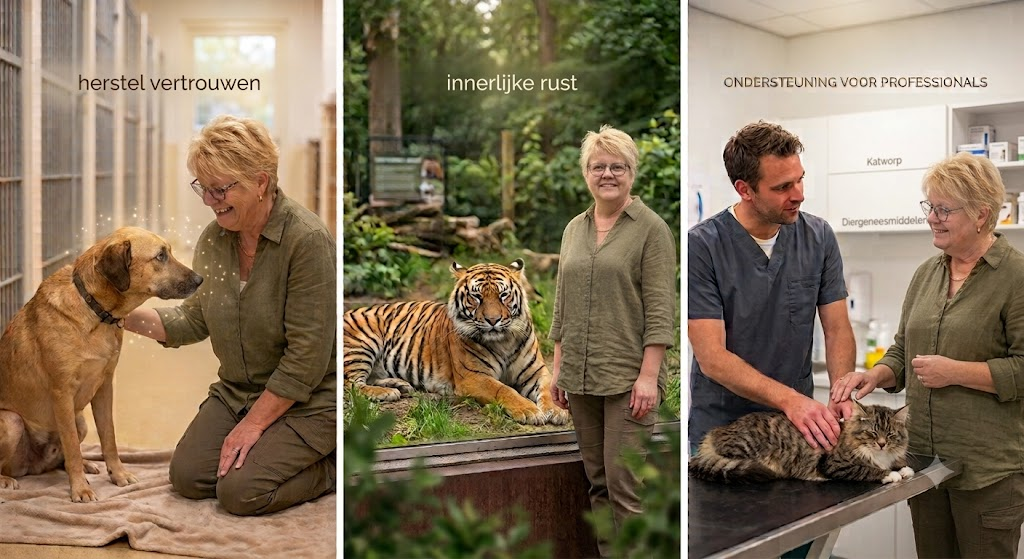
Every sector has its own challenges. See below how this combined approach can support your team:
🐾 Animal Shelters and Rescue Centers
Animals in shelters and rescue centers often experience a lot of stress and/or often have a difficult past.
- Faster resocialization: By processing traumas / fears / anxiety using the Trust Technique, animals become calm and approachable more quickly.
- Better matching: By carefully observing and listening (body language) to the animal's needs, you increase the chance of a successful, permanent placement with a new family.
- Calm in the kennels: The calming effect of the Trust Technique often has a positive ripple effect on the other animals in the room.
🩺 Veterinarians and Clinics
A visit to the clinic is a stressful event for many animals.
- Support for vague complaints: The Trust Technique can (as a supplement to your medical expertise) provide guidance for unexplained pain signals.
- Stress-free treatments: By using the Trust Technique with extremely anxious/restless patients, a calm atmosphere is created in the treatment room. This makes examination and treatment safer and easier for the animal, the owner/caretaker, and the veterinarian.
🦒 Zoos and Care Farms
Let me start by saying that I am not an animal trainer. However, group dynamics play a major role in managing groups of animals and (wild) animals in captivity.
- Calming herd dynamics: Is one animal being ostracized? Is there unrest in the pack or herd? The Trust Technique brings calm, directly from the animals themselves.
- Breaking stereotypical behavior: The Trust Technique helps animals get out of survival mode (fight/flight) and let go of stereotypical behavior caused by stress, fear, or boredom.
A collaboration, how does that work in practice
A collaboration is always custom-made, tailored to the needs of your organization. This can vary from:
- Consultations on request: For example, regarding a specific 'problem animal' that your team is struggling with. We start with an introductory online or telephone call, after which I can potentially visit for a Trust Technique session. In this session, the animal's caregiver is always involved and included in the process so that they, too, learn to convey calmness to the animal in question.
- Project-based support: Regular visits to your agency to work with the most traumatized animals.
- Workshops & Knowledge Sharing: Familiarizing your caregivers or volunteers with and training them in the basic principles of the Trust Technique, so that they can bring more calm to their daily work.
When we stop trying to change the behavior, and instead heal the underlying emotion, space is created for true trust.
Let's get acquainted
Are you curious how the Trust Technique can support your organization in improving animal welfare and relieving your team's workload?
I would be happy to make time in my schedule to get to know you without obligation, online or by phone, once I receive the intake form or contact form from you.
Tip: Before filling out the intake form, first record a video clearly showing the problem behavior of the animal(s) you would like me to focus on. You can then upload this to the intake form.